Australia's Water Future: Two Diverging Paths
Key decision points: Urban: Atmospheric Water Generation machinery (proven, capital-intensive) Rural/Basin: AWG networks + agricultural efficiency (scalable, distributed, emerging) Timeline: Action needed by 2030 to avoid stress escalation post-2040
Aug 29, 2026
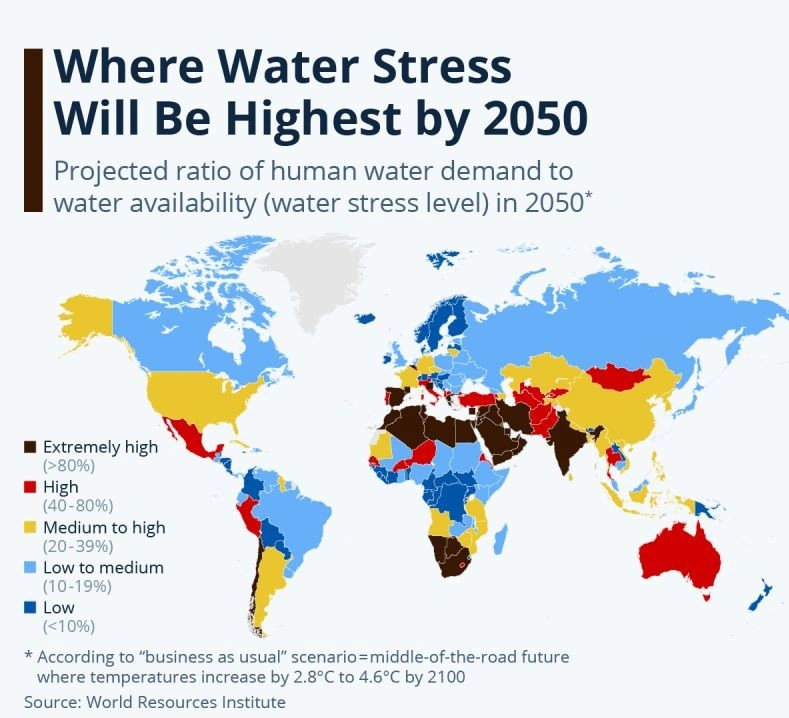
Australia's Water Future: From Crisis to Opportunity
The Real Pressure Point
Agriculture consumes 70% of Australia's water but contributes just 2–3% to GDP. Yet here's the good news: agricultural productivity per megalitre has jumped 35–45% in two decades, leaving room for 10–20% further efficiency gains without sacrificing output. While water production is a capability, water security and resilience are the resulting outcomes.
What's happening: Infrastructure investment + diversified supply = resilience.
The Murray-Darling Basin: A Three-Part Solution
This is where Australia's real water challenge lives—and where innovation can make the difference.
The Challenge:
Operating at 95–110% of sustainable yield
Only 15–20 days of storage on hand
10–15% rainfall decline + 8–12% evaporation increase by 2050
Projected stress index: 38–48 (critical threshold)
The Solution Path:
Agricultural efficiency (15–25 years)
Targeted 10–15% demand reduction through precision irrigation
Low cost; immediate impact
Atmospheric Water Generation >–15 years)
AWG machines extract potable water directly from air - Humid air!
Capacity: 500–50000+ liters/day per unit or modulars (varies by humidity, technology, location) higher at night.
Energy cost: $2–8 per 1,000 liters (dropping 30–40% by 2030 with scale) A combination of solar power and battery storage is recommended.
Ideal for distributed rural supply; reduces reliance on basin storage
Deployable in 50–100+ unit modular clusters across drought-prone regions
Expanded water generation+ storage (15–30 years+ per unit)
Regional-water networks for agricultural and high volume business use
Strategic storage expansion in high-yield years
Combined impact: These three pathways can reduce stress indices from 38–48 to 28–35 by 2050—moving from critical to manageable.
The Bottom Line
Australia's water stress isn't uniform or unsolvable. Cities investing in alternative supplies will adapt.
Rural regions relying on rainfall now have a practical tool: AWG deployment offers reliable, scalable water independence without depleting aquifers or rivers.
The real challenge lies not in finding additional water, but in establishing infrastructure that maintains water quality, reliability, investment around an entire-system and environmental integrity indefinitely.
These expenditures are infrastructure, not shortcuts. They build resilience that pays dividends across generations.
Treating water infrastructure as investment—not expense—is the difference between managed adaptation and crisis response. Infrastructure capital deployment ensures long-term supply resilience.
Underfunding today creates scarcity tomorrow.