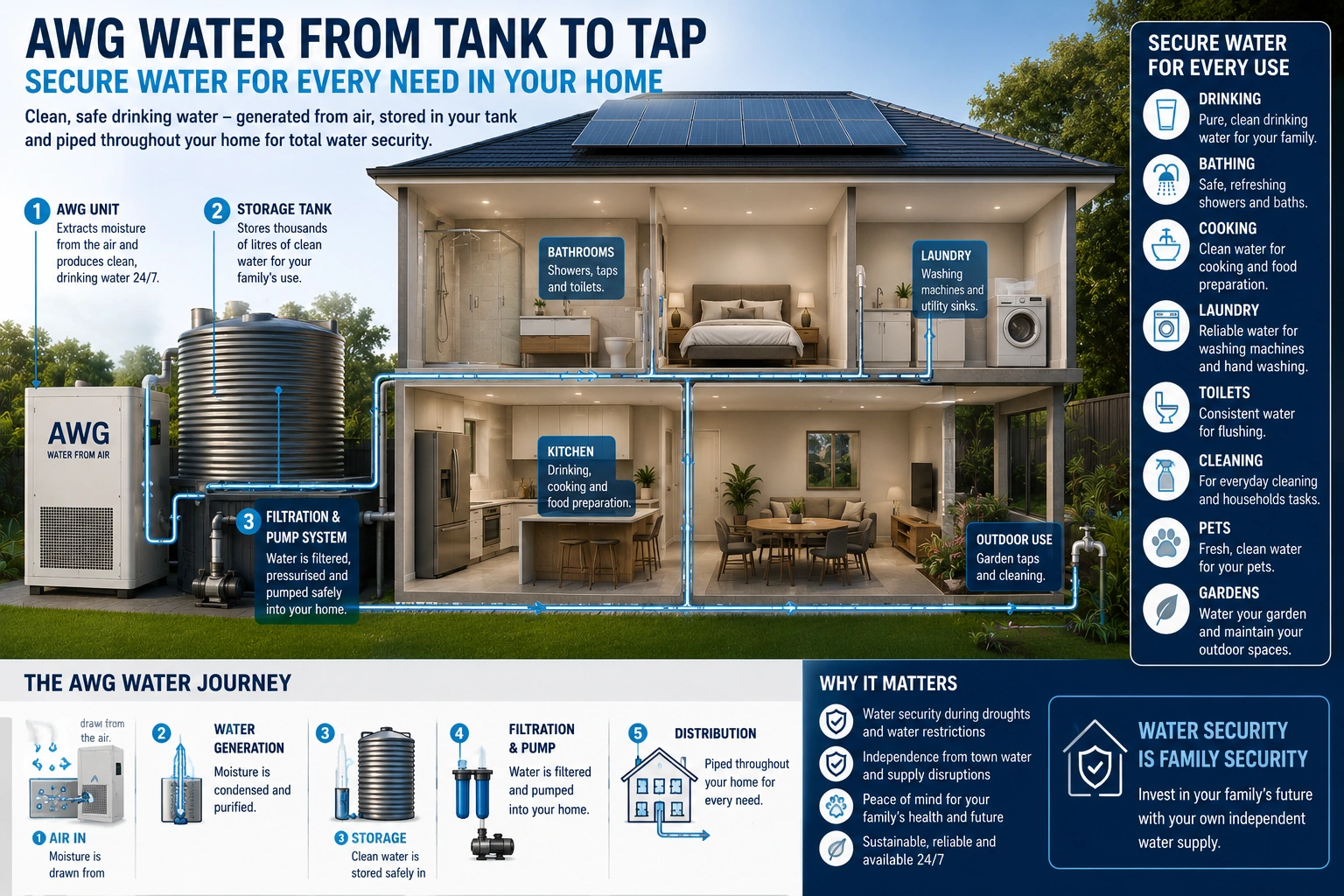
Generate. Store. Distribute. Secure. Your own independent water supply—produced from the air, stored on-site, and available whenever your family needs it.
GENAQ’s 500 L/day class models are listed around 502–506 L/day, using about 5.1–5.5 kW and 0.24–0.26 kWh/L under certified chamber conditions.
Aug 7, 2026
During periods of severe drought, governments may be forced to introduce progressive water restrictions as growing demand from communities, businesses, agriculture, and AI-driven data centres competes for limited water resources.
While no one can predict future rules, past Australian droughts provide a guide.
Households Could Face:
No garden watering during certain hours or days
Restrictions on sprinklers and irrigation systems
No washing cars with hoses
Limits on filling swimming pools
Reduced pressure on water supplies
Water-efficient appliance requirements for new homes
Higher water pricing for excessive use
Businesses Could Face:
Limits on landscape and garden irrigation
Restrictions on pressure cleaning
Water-use reporting requirements
Mandatory water-saving technologies
Reduced water allocations for some industries
Higher commercial water tariffs
Restrictions on non-essential water use
Agriculture Could Face:
Reduced irrigation allocations
Water trading costs increasing
Restrictions on surface water extraction
Bore and groundwater monitoring
Increased competition for available water resources
Why Some Experts Are Concerned
Australia's future water demand is expected to increase from:
population growth
climate variability
industrial development
manufacturing
mining
AI and data centre expansion
Recent reports have highlighted that large data centres may require substantial water supplies for cooling, prompting calls for improved water planning and management. However, governments have not announced that households or businesses will lose water because of AI. Rather, the concern is that all users will be competing for the same finite resource during drought periods.
Why Businesses Are Looking At AWG
For many businesses, AWG is not about replacing all water use. It is about securing an independent drinking water supply that is:
available during restrictions
not dependent on dams
not dependent on town water
scalable for offices, farms, workshops and remote sites
compatible with solar and hybrid energy systems
The key question for Australian homes and businesses may become:
If water restrictions return, how much control do you want over your own drinking water supply?
What would it mean for your family or business to own an independent water supply generated from the air — not just today, but for decades to come?