Australian Water Legislation: What It Means for Farm Water Security
1983 — The Constitutional Turning Point
Aug 7, 2026
Key legislation, 1983–2026
Water law in Australia has been shifting for over 40 years — and for farmers, each shift has touched how much water is available, what it costs, and how much certainty you can plan around. Here's a plain-English look at the key milestones, and why water security is worth taking into your own hands.
1983 — Tasmanian Dam Case The High Court approved Commonwealth use of trade/commerce and external affairs powers to intervene in water and environmental regulation — this set the constitutional foundation for federal involvement in water that follows through everything below. Forum of Federations
1983 — The Constitutional Turning Point
It started with a court case, not a water law. The High Court's 1983 Tasmanian Dam decision confirmed the Commonwealth's power to intervene in water and environmental regulation using its trade and external affairs powers. This ruling became the legal foundation for almost everything that followed — it's the reason federal governments can act on water policy at all, rather than leaving it entirely to the states.
What it means for farmers today: Water management in Australia isn't just a state or local issue — it can be shaped by federal decisions, and has been ever since.
1994–2007 — Water Becomes a Market
1994–2007 — COAG water reforms COAG secured federally driven water reforms through competition law changes and the creation of water markets in each state — this is when water became a tradeable commodity, not just a farming input, which set up the price volatility farmers deal with today. Forum of Federations
Through the Council of Australian Governments (COAG), water reform moved water from something farmers simply used to something farmers could buy, sell, and trade — separate water markets were established in every state. This unlocked flexibility, but it also meant water's price could now rise and fall with market forces, not just seasonal supply.
What it means for farmers today: Water costs are no longer just about rainfall — they're influenced by market dynamics well beyond any one farm's control.
2007 — Water Act 2007 (Cth) Established Commonwealth management of Murray–Darling Basin water resources, enabling the Commonwealth to enforce compliance and intervene with Basin state governments. This is the legal spine of everything since — it's why federal buybacks are even possible. Wikipedia
Through the Council of Australian Governments (COAG), water reform moved water from something farmers simply used to something farmers could buy, sell, and trade — separate water markets were established in every state. This unlocked flexibility, but it also meant water's price could now rise and fall with market forces, not just seasonal supply.
What it means for farmers today: Water costs are no longer just about rainfall — they're influenced by market dynamics well beyond any one farm's control.
2007 — The Water Act
The Water Act 2007 gave the Commonwealth formal authority over the Murray–Darling Basin, Australia's most significant agricultural water system. It set the legal framework for federal enforcement and intervention across five states and territories — laying the groundwork for the Basin Plan that followed.
What it means for farmers today: This is the legislation that made federal water buybacks possible — a tool still shaping water availability nearly two decades later.
2012 — Murray–Darling Basin Plan Set the cap on total water extraction across the Basin — this is the plan currently under review (see below), and it's the reason regional water availability for irrigation has been progressively tightened.
The Basin Plan set hard limits on how much water could be extracted from the Basin for irrigation and other use, in order to protect the river system long-term. For irrigators, this meant a cap on future access — a defining constraint still felt today.
What it means for farmers today: The Basin Plan is the reason water allocations have tightened progressively since 2012, and it remains the framework governing water availability in the region.
2023 — Restoring Our Rivers
2023 — Water Amendment (Restoring Our Rivers) Act Returned voluntary water buybacks as a key tool to deliver the Basin Plan — Note NSW Farmers' Association and multiple regional councils opposed expanded buybacks and the removal of socio-economic protections for their communities. The Australia Institutensw
The Water Amendment (Restoring Our Rivers) Act reinstated voluntary water buybacks as a primary tool for meeting Basin Plan targets. It's a voluntary program — no farmer is forced to sell — but its scale has drawn strong reaction from farming communities and regional councils concerned about flow-on effects for irrigators who remain in the system.
What it means for farmers today: As water is voluntarily recovered from the productive market, the water that remains can become more valuable — and more expensive for those still relying on it.
2025 — Buybacks Continue
A further 130 gigalitres of Murray–Darling Basin water buybacks was announced in late 2025. Industry groups, including dairy farmers, raised concerns about the impact on production and regional jobs, along with upward pressure on temporary water prices for irrigators who hadn't sold.
What it means for farmers today: Every buyback round reduces the pool of water available to the remaining irrigators — a dynamic that continues to influence water costs.
2025 — Further buyback rounds Federal Water Minister Murray Watt announced a further 130 gigalitres of Murray-Darling Basin water buybacks in late 2025, which dairy farmers warned would harm milk production, regional jobs, and place upward pressure on temporary water prices for remaining irrigators. The LandThe Land
2026 — Basin Plan Review (happening now) The Basin Plan Review is occurring in 2026, with an Expression of Interest purchasing process for northern Basin catchments open March–April 2026, currently being evaluated — this is live and ongoing right now. The Australia InstituteDCCEEW
2026 — The Basin Plan Under Review
Right now, the Murray–Darling Basin Plan is undergoing a scheduled review, alongside an active Expression of Interest process for further water purchasing in northern Basin catchments. The outcome of this review will shape water policy for years to come.
What it means for farmers today: Water security and cost remain a live, unresolved question — not a settled one.
Why This History Matters
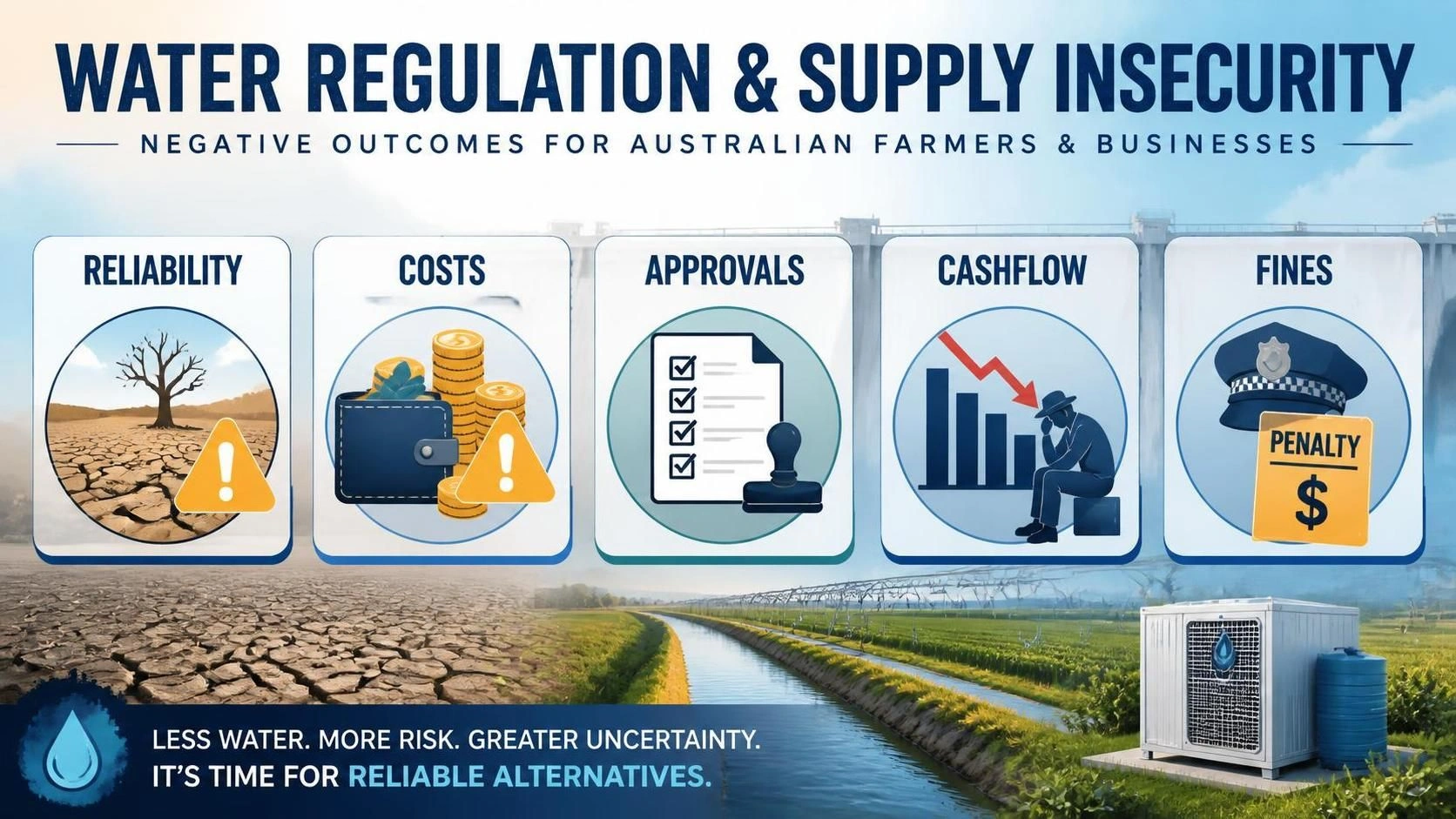
Four decades of water reform tell one consistent story: the water available to Australian farmers is shaped as much by policy as by rainfall. Buybacks, market trading, and Basin Plan limits all influence supply and cost — regardless of how much rain falls in any given season.
This is exactly why more farmers are looking at water sources they can control directly. Atmospheric Water Generation (AWG) doesn't rely on river allocations, dam levels, or water market prices — it generates clean water on-site, from the air, independent of the policy landscape entirely.
Curious whether AWG could reduce your farm's exposure to water policy and market shifts?
[Get a free water assessment] and find out what's possible for your property.
This article summarises publicly available legislative history for general information purposes and does not constitute legal or financial advice. Water buybacks remain a debated policy area among farming communities, industry groups, and environmental organisations — this summary aims to present the facts of what has changed, not to take a position in that debate.