Negative outcomes for farmers and water-dependent businesses from tighter/changed Australian water legislation (and enforcement)
Tend to cluster around five big areas with a huge impact.
Aug 7, 2026
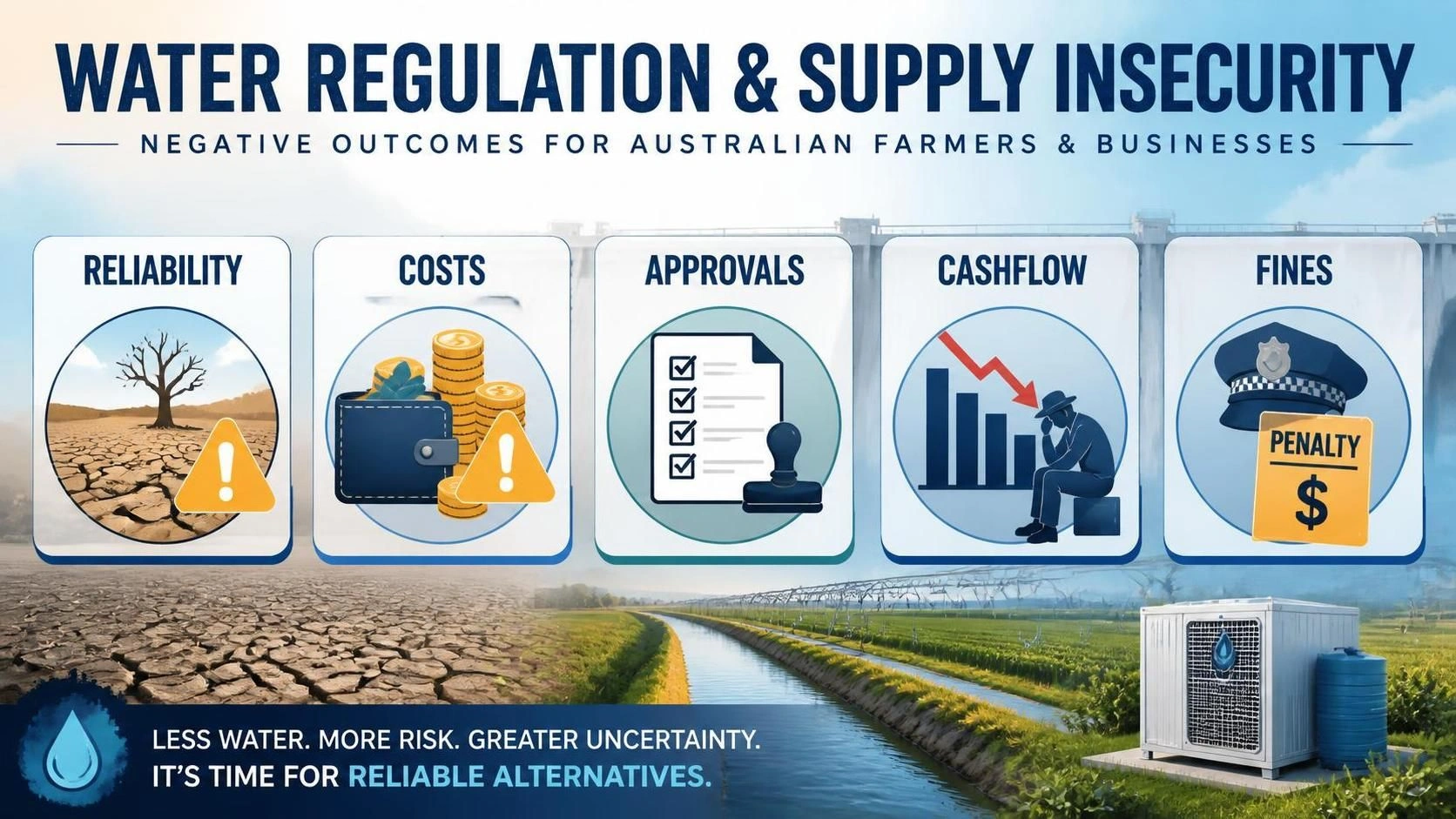
1) Less reliable access (security of supply)
Allocation cutbacks and tighter rules can mean you can’t rely on getting the same volume each season.
Temporary restrictions during drought or “overdrawn” systems can turn planned operations into shortfalls.
2) Higher operating costs
Extra compliance work: metering upgrades, reporting, record-keeping, audits.
Monitoring/measurement requirements can increase labour and consultant costs.
Costs rise specifically during dry periods because you operate closer to legal limits.
3) Capital expenditure pressure
To stay compliant or secure supply, businesses may need:
new bores, bores capped/approved, or groundwater works upgrades,
lined channels/pipelines instead of open flow,
farm dams/tanks, treatment, reuse systems,
automation for irrigation and water accounting.
If approvals slow down or requirements change mid-project, costs can jump.
4) Trade/market impacts (price, competition, cashflow)
Water trading restrictions or tougher rules on transfers can reduce flexibility when you need water most.
If temporary water markets tighten, water can become expensive quickly, hitting cashflow.
Businesses that can’t pay high short-term water prices can lose production volume or market position.
5) Risk of penalties and business disruption
Reporting or measurement errors (even unintentional) can lead to enforcement action, fines, or loss of entitlements.
In some cases, businesses may face forced reductions during investigations or compliance crackdowns.
Uncertainty itself becomes a cost: lenders, insurers, and customers may view water-dependent operations as higher risk.
6) Environmental compliance can reduce production opportunities
Stricter environmental flow requirements can reduce water available for irrigation.
Seasonal rules can force fallowing, crop switching, or reduced stocking (for livestock) which directly impacts income.
7) Bottlenecks in approvals
Approval delays for new groundwater take, new infrastructure, or expansions can stall projects.
If rules “remake” (updated standards/regulations), older proposals can become non-compliant and need redesign.